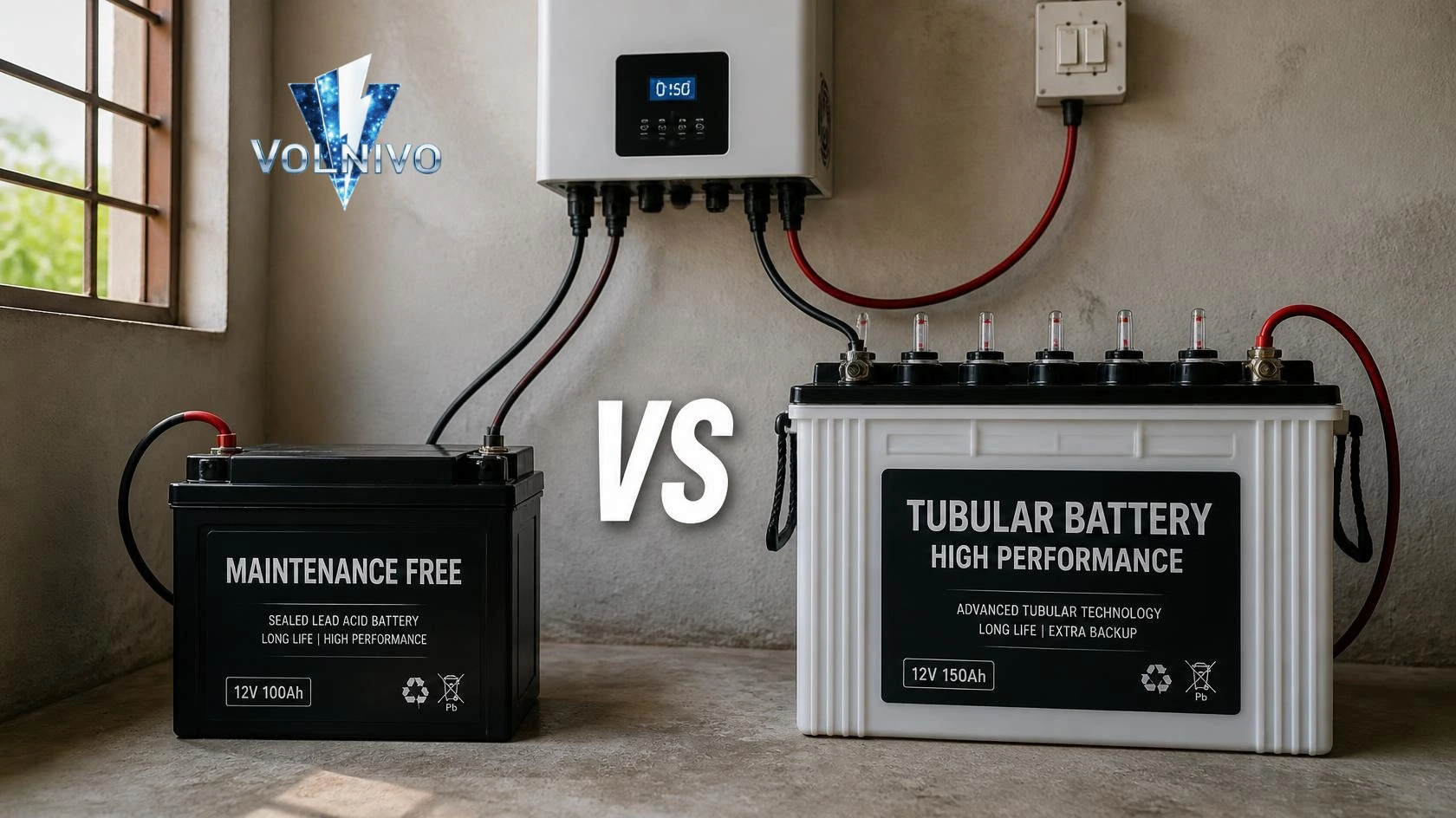
If you’re buying an inverter or UPS battery for your home or office, the Dry Battery vs Tubular Battery decision is usually the first thing you’ll get stuck on. Both are built for power backup, but they work differently, cost differently, and suit different needs. Walk into any battery shop, and you’ll hear conflicting advice: one salesman pushes dry batteries for “zero hassle,” another pushes tubular for “better value.” Both are right, depending on your situation.
Short answer: if you want zero maintenance and have occasional power cuts, go for a dry battery. If you face frequent or prolonged power cuts and don’t mind basic upkeep, a tubular battery offers better value and backup.
This guide breaks down the Dry Battery vs Tubular Battery comparison in detail, how each one works, what they cost over time, and which one actually fits your situation, not just the shop’s recommendation.
What is a Dry Battery?
A dry battery, also called a maintenance-free (MF) or sealed lead-acid (SLA) battery, is built with a sealed casing that doesn’t need water top-ups. Inside, the electrolyte is either in gel form or absorbed into a fiberglass mat, which is why there’s no liquid to check or refill. This is the core design difference behind the Dry Battery vs Tubular Battery debate.
Because the battery is sealed, it doesn’t release gas or fumes during normal charging, unlike older battery types. It doesn’t require ventilation, doesn’t spill if tilted, and doesn’t need you to open it up and inspect it. You install it once and mostly forget about it until it needs replacing.
Dry batteries are commonly used in homes with occasional power cuts, small offices, and setups where space is limited. Since they’re sealed, they’re also safer around kids and pets, and there’s no risk of acid spillage. They’re also a common choice for UPS systems protecting computers and sensitive electronics, where a stable, low-maintenance power source matters more than raw backup time.
One thing to watch for in hot climates: dry batteries are more sensitive to high temperatures than tubular batteries. If your inverter room gets very hot and isn’t ventilated or cooled, a dry battery’s lifespan can drop noticeably faster than its rated 3-4 years.
What is a Tubular Battery?
A tubular battery uses a tubular plate design, where the active material (lead oxide paste) is packed inside cylindrical tubes made of a strong, porous material. This construction keeps the active material in place better than flat-plate designs, which reduces shedding and wear over repeated charge-discharge cycles.
This is what makes tubular batteries more durable and better at handling deep discharge cycles, situations where the battery is drained heavily during long power cuts and then recharged. The tubular design was originally developed for industrial and heavy-duty applications, which is part of why it holds up well in homes with frequent, long outages.
Unlike dry batteries, tubular batteries are flooded lead-acid batteries, meaning they use liquid electrolyte. This means they need regular water top-up, usually every 3 to 6 months, to keep working efficiently. Skipping this step causes the plates to dry out and lose capacity over time. Tubular batteries are widely used in homes and businesses located in areas with frequent or extended power outages, where their longer backup time and durability matter more than convenience.
Dry Battery vs Tubular Battery: Key Differences
Here’s a side-by-side breakdown of the factors that actually matter when you’re buying:
| Feature | Dry Battery | Tubular Battery |
| Maintenance | None required | Regular water top-up needed |
| Lifespan | 3-4 years | 5-8 years (up to 10 for tall tubular, well maintained) |
| Price | Higher upfront cost, often nearly double | Lower upfront cost |
| Backup Time | Moderate | Longer, better for deep discharge |
| Charging & Deep Discharge | Sensitive to deep discharge | Handles deep discharge and charging cycles better |
| Heat Sensitivity | Degrades faster in high heat | More stable across temperature swings |
| Space Required | Compact | Bulkier |
| Weight | Lighter | Heavier |
| Gas/Fume Release | Sealed, minimal | Vents gas, needs ventilation |
| Risk of Spillage | None (sealed) | Possible if mishandled |
| Best For | Occasional, short power cuts, indoor/apartment use | Frequent, long power cuts, hot climates |
Overall, if your usage involves solar or heavy deep-discharge cycles, tubular batteries hold up better without needing an upgrade. And in the Pakistani market, tubular batteries generally cost noticeably less than dry batteries of similar capacity, often close to half the price.
Battery Price Comparison in Pakistan (PKR)
Price is often the deciding factor in the Dry Battery vs Tubular Battery decision. Actual pricing varies by brand, capacity (Ah), and plate design, but here’s a general picture based on the current Pakistani market:
- Tubular batteries: Standard 180Ah-200Ah tall tubular models typically range from roughly PKR 42,000 to PKR 55,000, depending on brand and plate count. Brands like AGS and Exide are common tubular battery options in Pakistan, known for their durability and wide dealer availability.
- Dry batteries: Pricing is less consistent and scales up faster at higher capacities. Sealed maintenance-free batteries can start lower for small UPS-sized units but climb quickly for high-capacity, deep-cycle-rated dry batteries, often ending up noticeably more expensive than a tubular battery of equivalent capacity.
- A note on lifespan: sources don’t fully agree here. Some rate standard tubular batteries at 3 to 5 years; others rate tall tubular models at 5 to 8 years or more when properly watered and maintained. The honest takeaway is that tubular lifespan depends heavily on the specific model (standard vs. tall tubular) and how consistently you maintain it; treat any single number as a rough estimate, not a guarantee, and check the warranty terms of the specific brand you’re buying.
- Prices change often, so treat these as a starting reference and confirm current rates with your local dealer before buying.
What About Deep-Discharge Use (Solar and Heavy UPS Loads)?
If your battery is going to be deep-discharged repeatedly, for example, in a solar setup or a UPS battery brand running heavy loads through frequent long outages, the maintenance-free convenience of a dry battery comes with a trade-off. Standard dry batteries tend to degrade faster under this kind of heavy, repetitive deep-discharge cycling than tubular batteries do.
If you specifically need a maintenance-free battery for a solar or heavy-load setup, the reliable way to avoid this degradation is to move up to a gel battery or a lithium-ion battery, both of which handle deep-discharge cycling far better than a standard dry (AGM/SLA) battery, but at a higher cost. If your budget doesn’t stretch that far and you’re doing heavy deep-discharge cycling, a well-maintained tubular battery is usually the more reliable choice over a standard dry battery.
Cost of Ownership: Which One Saves You More Over Time?
Upfront price isn’t the full picture. A tubular battery typically costs close to half the price of a dry battery of similar capacity and usually lasts longer — 5 to 8 years, or up to 10 years for tall tubular models with proper watering. The trade-off is distilled water top-ups every 3 to 6 months. A dry battery costs more upfront, sometimes nearly double, but needs zero maintenance. Its lifespan is shorter and more variable, typically 3 to 4 years, and drops faster in a hot, poorly ventilated space, which is common in Pakistan’s climate.
Rough math: a tubular battery costing roughly half as much and lasting 8-10 years with basic upkeep could outlast two to three dry battery replacements over the same period. For budget-conscious buyers willing to do minimal maintenance, tubular batteries generally offer better long-term value. For buyers who prioritize convenience and indoor placement, the extra upfront cost of a dry battery may still be worth it.
Maintenance: What Each Battery Actually Requires
Maintenance is the single biggest practical difference in the Dry Battery vs Tubular Battery comparison. Here’s what each one actually needs day-to-day:
Dry battery maintenance:
- No water top-up needed
- Keep terminals clean and free of corrosion
- Ensure proper ventilation around the battery, even though it’s sealed
- Avoid deep discharging it repeatedly, as this shortens lifespan
Tubular battery maintenance:
- Check water levels every 3 to 6 months
- Use only distilled water for top-ups, never tap water
- Clean terminals regularly to prevent corrosion
- Keep the battery in a ventilated area since it releases gas during charging
- Avoid overcharging or letting it sit in a fully discharged state for long periods
If you’re not confident you’ll keep up with the tubular battery’s maintenance schedule, that alone might be reason enough to go with a dry battery; a well-maintained tubular battery outperforms a neglected one by a wide margin.
Pros and Cons of Dry Battery
Pros:
- Zero maintenance, no water top-up needed
- Sealed design, safer and cleaner
- Compact size, fits in tight spaces
- Faster charging
- No fumes or gas release during normal use
- Better suited for enclosed or indoor spaces
Cons:
- Higher upfront price, often nearly double a tubular battery
- Shorter lifespan compared to tubular (typically 3-4 years)
- Performance drops faster in hot climates
- Not ideal for very long or frequent power cuts
- Costlier to replace when it does wear out
Pros and Cons of Tubular Battery
Pros:
- Longer lifespan with proper maintenance (5-8 years, up to 10 for tall tubular)
- Better backup during long power cuts
- Generally cheaper upfront, often close to half the price of a dry battery
- Handles deep discharge cycles well
- More stable performance in hot climates
- Well-suited for high-usage, frequent power cut areas
Cons:
- Needs regular water top-up
- Bulkier, needs more space
- Risk of acid leakage if not handled properly
- Requires ventilation due to gas release
- Performance drops significantly if maintenance is skipped
Common Myths About Dry and Tubular Batteries
A lot of bad buying decisions in the Dry Battery vs Tubular Battery debate come from repeating myths instead of checking facts. Here are the most common ones:
- Myth 1: Dry batteries always last longer than tubular batteries. Not true. Tubular batteries typically outlast dry batteries when properly maintained. The “dry battery lasts longer” idea likely comes from confusing “maintenance-free” with “longer-lasting”; they’re not the same thing.
- Myth 2: Tubular batteries are dangerous because they use liquid. Tubular batteries are safe when handled correctly. The liquid electrolyte only becomes a risk if the battery is tilted, damaged, or severely neglected. Normal home use with basic care carries minimal risk.
- Myth 3: A more expensive battery always performs better. Price reflects manufacturing cost and convenience features, not necessarily performance. A well-maintained tubular battery can outperform a similarly priced dry battery in backup time and lifespan.
- Myth 4: Dry batteries charge faster than tubular batteries. This isn’t consistently true. Some sources report tubular batteries actually handle charging and deep discharge cycles better than standard dry batteries. Charging speed depends more on the specific battery model and inverter settings than on whether it’s dry or tubular; don’t treat this as a deciding factor.
Dry Battery vs Tubular Battery: Which One Should You Buy?
Buy a dry battery if:
- You want a maintenance-free setup
- Your area has occasional, short power cuts
- You have limited space
- You’re okay paying more upfront for convenience
- You don’t want to deal with ventilation or water top-ups
Buy a tubular battery if:
- Your area faces frequent or long power cuts
- You’re working with a tighter budget
- You don’t mind basic maintenance every few months
- You need longer battery life over time
- You have adequate space and ventilation available
If you want a straightforward rule: choose a dry battery for convenience, choose a tubular battery for value and backup power over time. Neither option is objectively “better”; the right choice depends entirely on your power cut frequency, budget, and how much upkeep you’re willing to commit to.
Conclusion
At the end of the day, the Dry Battery vs Tubular Battery choice comes down to your power cut pattern and how much maintenance you’re willing to handle. Dry batteries win on convenience and maintenance-free use. Tubular batteries win on lifespan, backup time, and value for money if you’re willing to do basic upkeep. Match your choice to your actual usage, not just the price tag or what a salesperson recommends. Still confused which battery suits your home or office best? Contact our team today for expert advice and get the right battery brand recommendation based on your exact power backup needs.
FAQs
- Which battery lasts longer, dry or tubular?
Tubular batteries usually last longer, around 5-8 years (up to 10 for tall tubular models) compared to 3-4 years for dry batteries.
- Is a dry battery better than a tubular battery for an inverter?
A dry battery is better if you want zero maintenance and don’t have frequent long power cuts. But if your area has long or frequent outages, a tubular battery gives better backup and value for money over time.
- Which is cheaper, dry or tubular battery?
Tubular batteries are significantly cheaper upfront compared to dry batteries of the same capacity; dry batteries often cost nearly double. However, dry batteries can offset some of that gap long-term since they need no maintenance and no water refills.
- Does a tubular battery need regular maintenance?
Yes, tubular batteries need periodic water top-up, usually every 3-6 months. Skipping this maintenance reduces battery life and performance significantly. Dry batteries don’t have this requirement at all.
- Which battery is better for frequent power cuts?
Tubular batteries are better suited for areas with frequent or long power cuts. They handle deep discharge cycles more efficiently and provide longer backup time. Dry batteries are better for occasional, short power cuts only.
- Can I use a dry battery instead of tubular in any inverter?
Most inverters support both battery types, but check your inverter’s specifications first. Some older inverter models are optimized for tubular batteries only. Always confirm compatibility before switching battery types.