Yes, solar-charging electric scooters in Pakistan actually work, and they’re more common in Pakistan than you’d think. But “does it work” isn’t really the question worth asking. The real question is whether it’s practical for your situation, given your electricity bill, your rooftop space, and how much you actually ride.
Load shedding hasn’t gone anywhere. Electricity bills keep climbing every few months. And a lot of scooter owners already have a few solar panels sitting on their roofs from years ago, wondering if their scooter can plug into that same setup. This guide walks through exactly how that works, what you’d need if you’re starting from zero, what it costs, and when it genuinely makes sense; no oversold promises, no vague theory about how solar panels work.
Can You Charge an Electric Scooter With Solar Power?
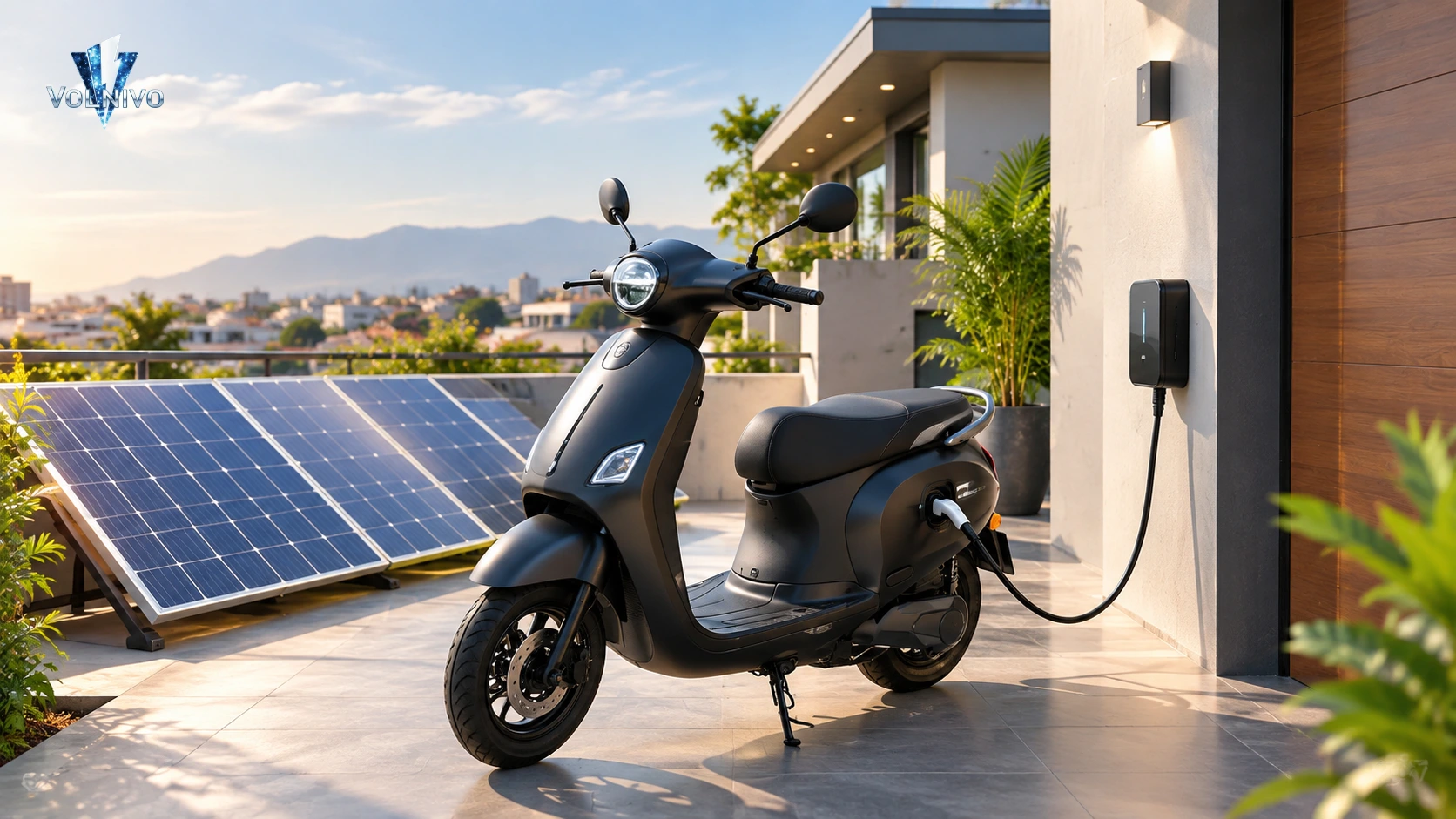
yes. But not by pointing a panel at your scooter and hoping for the best. Solar charging an electric scooter in Pakistan requires the same basic chain as charging anything else off solar: panels generate electricity, an inverter turns that into usable power, and your scooter’s original charger takes it from there. You’re not connecting solar panels directly to your battery. The system just replaces the electricity that would normally come from the national grid, and your scooter charges exactly the way it always has.
How Does Solar Charging Actually Work?
Keep this picture in your head, because it’s genuinely this simple. There are four steps here, and each one does one specific job; nothing complicated, nothing that needs an electrician’s manual to understand.
1. Solar Panels
This is where it all starts. Panels sitting on your roof soak up sunlight and turn it into raw electricity; the same panels do this whether they’re powering your fridge or, eventually, your scooter.
2. Inverter
Raw solar power isn’t in a form your charger can use straight away. The inverter takes that energy and converts it into regular household-style electricity, the kind that comes out of a normal wall socket.
3. Household Electricity
At this point, it’s genuinely no different from grid power. Once the inverter’s done its job, the electricity behaves exactly like what WAPDA would send you: same voltage, same socket, same everything.
4. Scooter’s Original Charger
This is the step people sometimes want to skip, and shouldn’t. Your scooter’s charger is what actually manages the flow into the battery safely, regulating voltage and current so nothing gets damaged.
By the time power reaches the battery itself, it doesn’t matter one bit whether it came from sunlight or the national grid; the scooter charges exactly the same either way. That’s really the whole point of this setup: nothing about your scooter or its charging routine changes, only where the electricity originally came from.
What Does the Setup Actually Require?
If you’re building this from scratch, here’s the real equipment list:
- Solar panels generate electricity in the first place
- A solar inverter converts that raw solar energy into the AC power your charger expects
- Battery storage (optional) is only needed if you want to charge at night or during cloudy stretches
- Your scooter’s original charger: this part never changes, and using anything else risks damaging your battery
Notice something important here: three of these four things, most homes with solar already have. That brings us to the part competitors usually skip. And whatever scooter you’re charging, whether it’s from the best electric scooter brand in Pakistan or a more budget-friendly option, the charging setup itself doesn’t change.
Already Have Home Solar? Here’s How Easy This Actually Is
If your house already runs on solar, or even partly on solar, a solar-charging electric scooter in Pakistan isn’t a project; it’s just plugging in.
There’s no separate panel-sizing calculation you need to do. Your existing system is already generating power for your fridge, fans, and lights. A scooter charger typically pulls somewhere between 100 and 500 watts, which is a small addition on top of a household system that’s already handling far bigger daily loads. If this is you, skip the calculations below entirely. Just plug in like you would a phone.
Building a Dedicated Setup? Here’s How Many Panels You’ll Need
Now, if you genuinely have no solar at home and you’re considering a setup purely to charge a scooter, the math changes, but it’s still not complicated.
It comes down to three things: your battery’s voltage and capacity (in Ah or Wh), how far you ride daily, and how much sunlight your area gets on an average day. A rough example: a 60 V 20 Ah scooter battery holds about 1,200Wh. A single 300W solar panel, getting 5 decent sunlight hours a day, produces roughly 1,500Wh, enough to fully charge that battery with a bit to spare, assuming reasonable inverter efficiency.
That said, standalone setups built purely for a scooter rarely make financial sense on their own, which is exactly what the cost section below explains.
Can Solar Power Charge 48V, 60V, and 72V Scooters?
Yes, across the board, the voltage of your scooter doesn’t change whether solar charging works, only how much solar capacity you’d want if you’re building a dedicated setup.
48V scooters need the least: smaller batteries, smaller daily energy draw. 60V scooters sit in the middle, typical for most mid-range models sold across Pakistan today. 72V scooters, usually the higher-range, higher-power models, need more panel capacity to charge fully within a day. None of this is a dealbreaker either way; it’s just a sizing question if you’re going the dedicated-setup route.
Solar Charging vs Grid Electricity: Which Is Better in Pakistan?
Neither one wins outright; it really comes down to how you ride and what you’re already paying for. Here’s the honest side-by-side so you can decide for yourself.
| Factor | Solar | Grid Electricity |
| Running cost | Very low once installed | Ongoing monthly bill |
| Upfront cost | Higher | Minimal to none |
| Affected by load shedding | No | Yes |
| Setup complexity | Moderate, one-time | None |
| Best for | Frequent riders, existing solar owners | Occasional riders |
Neither option is universally “better”; it genuinely depends on how often you ride and whether you’re already paying for solar anyway.
How Much Does This Actually Cost?
Let’s be upfront: nobody should be told solar charging is “free.” It’s cheap to run once it’s installed, but not free to set up.
- Already have home solar? Added cost is essentially nothing; you’re just using capacity you already paid for
- Building a dedicated setup from zero? Budget for one or two solar panels, a basic inverter, and installation labor
- The real upfront cost pays itself back over time if you’re riding daily and watching your electricity bill.
Solar Battery Price in Pakistan 2026: Updated Price List
Benefits of Solar Charging Electric Scooter in Pakistan
Once the setup is in place, the upside adds up fast; here’s what you’re actually gaining.
- Noticeably lower charging costs over time, especially for daily riders
- Protection against Pakistan’s regularly rising electricity rates
- Keeps charging possible during load shedding, if paired with battery storage
- A genuinely cleaner way to power your ride
- Makes the most sense for people already riding long distances daily
None of these benefits show up overnight, though. They stack up gradually, month after month, which is exactly why this setup makes more sense for daily riders than for someone who takes their scooter out once or twice a week.
Limitations Worth Knowing
No setup is perfect, and it’s worth going in with eyes open about what solar charging can’t fix.
- Solar output depends on the weather; cloudy days genuinely reduce charging
- There’s a real upfront cost if you’re starting from scratch
- Panels need physical space, which isn’t always available
- Night charging needs battery storage, which adds to the cost
None of these are dealbreakers on their own, but together they’re exactly why solar charging fits some riders far better than others.
Is Solar Charging Worth It for You?
It’s a good move if:
- You already have a home solar system in place
- You ride daily, and your electricity bill reflects that
- You’re looking to reduce long-term running costs, not just this month’s bill
It’s probably not necessary if:
- You only ride occasionally
- Your current electricity cost for charging is already manageable
- You’re not interested in any upfront installation cost, however small
Final Verdict
Solar Charging Electric Scooter in Pakistan genuinely works, and for a lot of Pakistani households, it’s less of a project than people assume. If solar’s already running your home, this is just one more thing plugging into a system you’ve already paid for. If you’re starting from scratch purely for a scooter, it’s a smaller, more manageable investment than most people expect; just don’t skip the inverter, and don’t skip your original charger.
At Volnivo, we’ve covered solar batteries, lithium options, and charging setups, so you’re never guessing about compatibility. Browse the latest electric scooters on Volnivo to find a model that fits your ride.
Contact us for the latest pricing and setup information. Call +92306-8492251, and we’ll help you figure out what actually makes sense for your situation.
FAQs
- Can I charge my electric scooter directly from a solar panel?
Not directly. You need an inverter between the panel and your scooter’s original charger; connecting a panel straight to the battery risks damaging it. - How many solar panels do I need to charge an electric scooter?
For a dedicated setup, typically one to two standard panels handle most scooter batteries, depending on voltage and daily riding distance. If you already have home solar, you likely need zero additional panels. - Does solar charging damage an electric scooter battery?
No, as long as you’re still using your scooter’s original charger and a properly sized inverter. The battery never “sees” a difference between solar and grid power. - Can I charge my scooter during load shedding using solar?
Yes, but only if your setup includes battery storage. Without storage, solar power is only available while the sun is actually out. - Is solar charging cheaper than electricity in Pakistan?
Over time, yes, especially for daily riders. The upfront setup cost is the main investment; running costs afterward are minimal. - Do I need a special charger for solar-charged scooters?
No. Your scooter’s original charger works the same whether the electricity comes from solar or the grid. - Can 72V electric scooters be charged with solar power?
Yes. Higher-voltage scooters just need a slightly larger solar setup to charge fully within a day, compared to 48V or 60V models. - Is it worth installing solar only for a scooter?
Usually not, unless you’re riding very long distances daily. It makes far more financial sense as an add-on to existing home solar rather than a standalone investment.
```html